

Running a pizzeria, bakery, or weekend bread hobby means your hands live in flour. Spiral mixers take the labor out of developing gluten, kneading dense doughs that would otherwise wear out your forearms. The right machine lets you scale production without sacrificing the texture that makes a good crust sing. Below, six models worth a closer look for kitchens ranging from small artisan setups to high-volume operations.
The Shortlist At A Glance
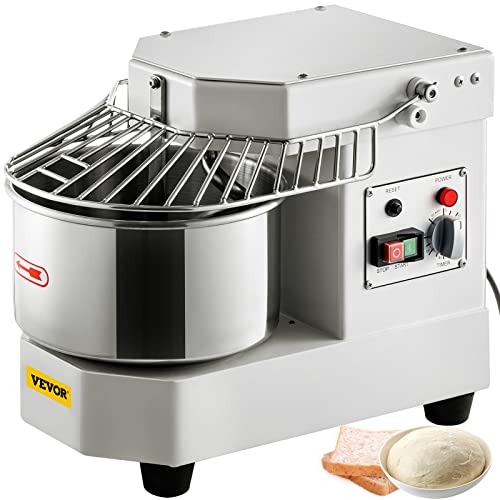
VEVOR 8.5Qt Commercial Food Mixer with Timer

TECHTONGDA Commercial 110V Spiral Dough Mixer 25KG

Garvee Commercial Dough Mixer 10.5 QT 650W

INTSUPERMAI 50L Commercial Spiral Mixer Double Action

Towallmark 10QT Commercial Food Mixer 3 Speeds

VEVOR 15Qt Commercial Food Mixer with Timer
Why These Options Stand Out
The VEVOR 8.5Qt sits in a comfortable middle ground for shops that need real capacity without dedicating an entire room to one appliance. Its 450W motor and dual-rotation setup handle roughly 6.6 lbs of dough per batch, which covers most pizzeria lunch rushes and small bakery production runs. The bowl, hook, and other food-contact parts are built from food-grade stainless steel, so cleanup after a long shift stays manageable.
A built-in timer helps crews walk away without babysitting the mix, and the security shield keeps hands safe during operation. For most new operations stepping up from a countertop stand mixer, this VEVOR offers a sensible first commercial step. It does not pretend to feed a stadium crowd, but for daily artisan work, it pulls its weight.
What Helps Most
- 6.6 lb dough capacity covers typical small-batch production
- Food-grade stainless bowl cleans up quickly after service
- Timer function frees you for prep work during mixing
- Security shield adds a practical safety layer
- Compact footprint compared to larger floor models
Things To Consider
- 450W motor may feel modest for very stiff, low-hydration doughs run back to back
- Single-bowl design means downtime between batches for cleaning
Feature Snapshot
Who It Suits Best
First-time commercial kitchen owners, artisan bakers, and small pizzerias ready to graduate from a countertop mixer.
Where Another Pick Suits Better
Operations producing 40+ pounds of dough per hour will outgrow the VEVOR 8.5Qt and should look at the INTSUPERMAI 50L instead.
The TECHTONGDA steps things up considerably with a 25 kg capacity that suits busy institutional kitchens. Its 90-degree tilt bucket makes dough removal far less awkward than reaching into a fixed bowl, and the pin-lock keeps the bowl from swinging during operation. Compared to the VEVOR 8.5Qt reviewed above, this is a real production tool, not a step up, more of a leap.
The twisted spiral hook design is intended to mimic hand kneading, working the dough from multiple angles. For school cafeterias, mid-sized bakeries, and catering operations, that capacity and tilt design tend to matter more than extra attachments. Just confirm your electrical setup can handle a 110V dedicated line before committing.
Where It Excels
- 25 kg capacity handles institutional batch sizes
- 90-degree tilt bucket simplifies dough extraction and cleaning
- Pin-locked bowl prevents dangerous swinging during cycles
- 110V power fits standard commercial circuits
Trade Offs
- Bulk and weight make placement a permanent decision, not a rearrange later
- Larger bowl means longer wash cycles at the end of service
- Fewer included accessories than the VEVOR 15Qt
Best Suited To
Mid-volume commercial kitchens, school food programs, and catering operations that run consistent large batches.
Skip It When
Small artisan bakerias making under 10 pounds of dough per day will find the TECHTONGDA oversized; the Towallmark 10QT is a better match there.
The Garvee 10.5QT delivers a noticeable power bump over entry-level units with a 650W copper motor, designed for kitchens that need consistent results batch after batch. Its dual-rotation design moves both the bowl and the hook, which helps develop gluten more evenly in roughly 10 to 15 minutes per load. The food-grade stainless bowl meets the hygiene standards most inspectors look for in commercial prep areas.
A timer and security shield round out the package. For a busy pizzeria or bakery running multiple dough types in a single shift, the extra motor headroom reduces the stalling you sometimes see on cheaper units. Owners of the VEVOR 8.5Qt who find themselves pausing between batches will recognize the difference immediately.
A Strong Showing
- 650W motor handles back-to-back batches without strain
- Dual rotation develops gluten more evenly in 10-15 minutes
- Up to 11 lb dough capacity per cycle
- Food-grade stainless construction throughout contact surfaces
- Security shield included for operator safety
Points To Note
- 10.5QT capacity sits in an awkward middle ground between small and large formats
- Higher power draw may require circuit verification in older buildings
Key Specs
Made For
Mid-sized pizzerias and bakeries running multiple heavy batches per shift who want extra motor reserve.
Look Elsewhere When
Operations needing true high-volume capacity should consider the INTSUPERMAI 50L for its larger bowl and double-action mixing.
The INTSUPERMAI 50L is the largest machine on this list, purpose-built for industrial-scale production. Its bowl measures roughly 15.7 by 11.22 inches and processes up to 40 pounds of dry flour in a single cycle. Double-action spiral mixing and a two-speed motor give operators real control, with a faster 240 rpm stirrer speed for lighter doughs and a slower 120 rpm for heavy artisan work.
Schools, commissaries, and wholesale bakeries running continuous production cycles tend to gravitate toward this class of machine. The trade-off is footprint and weight; this is not an appliance you tuck into a corner. The honest read is that for a small cafe, it would simply sit idle most of the day, but for the right operation, it replaces a small crew.
Points In Its Favor
- Processes up to 40 lb of dry flour per cycle
- Two-speed motor adapts to soft and stiff doughs
- Double-action mixing produces consistent texture
- Heavy-duty build designed for daily industrial use
Practical Considerations
- Large footprint demands a dedicated prep space
- Overkill for shops running under 20 lb of dough per day
- Sanitizing a 50L bowl takes longer than smaller models
Who Should Grab It
Industrial bakeries, school districts, and large restaurants producing high dough volumes every service.
Another Choice May Suit
The Garvee 10.5QT covers mid-range needs with far less space commitment for smaller operations.
The Towallmark 10QT brings a useful feature to first-time commercial owners: three-speed control. That range lets you ease dough into the mix at low speed before ramping up, which matters more for stiff low-hydration doughs than most spec sheets admit. Its 450W motor pairs with a 10QT stainless bowl, and non-slip feet help reduce walkaway vibration on tile floors.
Independent START and STOP buttons keep operation straightforward, even for staff cross-trained from front-of-house roles. All food-contact parts use food-grade 304 stainless steel, which is the grade most health inspectors expect to see in commercial prep. For a new pizzeria or bakery testing its first dedicated mixer, the controls feel intuitive without overcomplicating the workflow.
A Few Highlights
- Three-speed control handles varied dough textures
- Food-grade 304 stainless on all contact parts
- Non-slip feet reduce vibration on hard floors
- Safety guard included for operator protection
- Independent start and stop controls simplify training
Honest Caveats
- 450W motor is the same class as smaller units, so high-volume runs may strain it
- 10QT bowl requires a stable counter with adequate clearance for the guard
Quick Facts
Perfect Match For
First-time commercial kitchen owners and small pizzeria operators who want simple, intuitive controls.
Reach For A Different Pick When
Operations needing higher power for continuous heavy batches will benefit from the Garvee 10.5QT 650W motor instead.
The VEVOR 15Qt is the more versatile sibling to the 8.5Qt reviewed earlier, and its real differentiator is the included attachment set. You get a dough hook for pizza and bagel dough, a flat beater for mashing potatoes or mixing cake batter, and a wire whip for lighter aerated mixes like whipped cream. The 500W motor sits in the middle of the pack, sized for kitchens that want one machine to handle several prep tasks.
The 15Qt bowl gives meaningful headroom over 8- and 10-quart units without jumping into floor-model territory. Compared to the single-task focus of the TECHTONGDA tilt-bucket, this VEVOR trades specialized dough capacity for general versatility. For cafes and small restaurants where the same machine kneads dough at 6 a.m. and whips meringue at 2 p.m., that flexibility is the real value.
What Makes Sense
- Three attachments cover dough, batters, and aerated mixes
- 15Qt capacity balances size and counter footprint
- 500W motor handles a wider range of ingredients
- Timer included for unattended operation
Small Caveats
- Switching attachments slows down back-to-back single-task production
- Mid-range power means truly industrial batches are out of reach
- Larger bowl requires more storage space when not in use
Whose Shelf It Belongs On
Cafes, small restaurants, and bakeries that run varied prep tasks beyond just dough in a typical day.
Swap It Out When
High-volume pizzerias running continuous dough production should choose the INTSUPERMAI 50L for its dedicated capacity.
What Matters Most Before Choosing Spiral Mixers
Capacity drives most buying decisions in this category, and the right size depends on your peak-hour dough output rather than average demand. A pizzeria doing 80 pies on a Saturday night needs far more bowl volume than a bakery making 30 loaves on a Tuesday morning. Undersizing creates bottlenecks during the rush; oversizing wastes counter space and cleaning time between batches.
Motor power matters more than most spec sheets suggest for stiff, low-hydration doughs like bagels or artisan bread. A 450W motor can handle moderate loads, but heavy continuous production reveals the limits quickly. Dual-rotation designs, where both the bowl and hook turn, tend to develop gluten more evenly than single-axis units.
Build quality shows up in the food-contact parts, with 304-grade stainless steel being the standard most health inspectors expect. Bowl removal and tilt-bucket designs cut cleanup time meaningfully in high-volume operations. For multi-purpose kitchens, check what attachments ship with the unit before assuming you can whip, beat, and knead with one machine.
Key Considerations Across These Picks
Where Shoppers Go Wrong
The most common error is buying a mixer sized for average demand rather than peak hours, which creates exactly the bottleneck a commercial mixer should solve. Another trap is ignoring electrical requirements; some larger units need dedicated circuits that older buildings may not have at the prep counter.
What The Higher Tier Buys
Stepping up in price typically delivers a stronger motor, larger bowl capacity, and more included attachments rather than dramatically different mixing mechanics. For operations running continuous heavy dough, the upgrade pays off in fewer batch stalls and faster cycle times. For lighter or varied prep, the mid-tier often covers real-world needs without the footprint.
Frequently Asked Questions
What size spiral mixer do I need for a small pizzeria? Most small pizzerias producing under 50 pounds of dough per shift find a 7 to 15-quart bowl sufficient. Larger operations serving 100+ pies per day should consider 25 kg or 50L class machines.
Can a spiral mixer handle bread dough as well as pizza dough? Yes, spiral mixers work well for both. The dual-rotation design develops gluten efficiently in dense artisan breads, though very stiff sourdoughs may need reduced batch sizes to avoid motor strain.
How often should a commercial spiral mixer be serviced? Daily cleaning of the bowl and hook is standard, with periodic inspection of belts, bearings, and motor brushes every few months depending on usage volume. Following manufacturer maintenance guidance extends service life.
What is the difference between a spiral mixer and a planetary mixer? A spiral mixer uses a fixed hook that turns inside a rotating bowl, which is efficient for heavy doughs. A planetary mixer uses a single rotating attachment in a stationary bowl, which is more versatile for batters and lighter mixes but less efficient for stiff doughs.
Are spiral mixers difficult to clean? Most spiral mixers with removable bowls or tilt-bucket designs clean in under 10 minutes with standard sanitizing procedures. Fixed-bowl models take longer since you cannot separate the components fully.



