

Counter space runs short, mornings move fast, and whole produce still needs to land somewhere. The right small juicer slots beside a coffee maker, handles a daily glass of greens, and cleans up in under a minute. The wrong one rattles, leaks, or demands pre-chopping every apple. This list sorts the two apart, focusing on footprint, feed chute size, yield, and the small day-to-day details that decide whether the machine gets used or shoved into a cabinet.
The Main Contenders

Nama J3 Compact Cold Press Juicer (White)
Anybear 200W Cold Press Slow Juicer 4.3″ Chute

TUUMIIST Cold Press Juicer 5.8″ Chute (Black)

TUUMIIST 3-in-1 Juicer for Juice, Sorbet & Nut Milk
TUUMIIST 3-in-1 Smart Touch Cold Press Juicer 6.5″ Chute

Anybear 350W Cold Press Juicer 4.9″ Chute
Breville BJE200XL Juice Fountain Compact (Silver)
Breville Juice Fountain Compact (Silver)
Anybear 200W Cold Press Juicer 4.3″ Chute

Hurom H320 Cold Press Juicer (Kale/Dark Green)
Inside Each Recommended Option
The Nama J3 is built for countertops that can’t afford a full-size machine. Its compact body and self-feeding hopper let you drop a recipe’s worth of produce in at once, then walk away while it works. For renters, van-lifers, or anyone cooking in a tight galley, that hands-free design turns a daily glass of greens into a five-minute task.
Cold-press juicers use a slow-turning auger that crushes and squeezes rather than spins at high speed, preserving more nutrients and producing drier pulp. The J3 leans fully into that approach, making it a thoughtful step up from entry-level masticating options without crossing into professional territory.
What Works In Its Favor
- Compact footprint leaves room for a coffee maker and toaster beside it.
- Hands-free hopper means less babysitting during a rushed morning.
- Cold-press extraction keeps flavors cleaner and pulp drier.
- Portable design is easy to store or pack for short trips.
Small Caveats
- The smaller chute means slightly more pre-cutting than wider-chute rivals.
- Slow-press patience is required, since the auger takes its time.
Made For
Solo juicers in apartments, studios, or RVs who value a quiet, no-fuss daily glass.
Reach For A Different Pick When
The Breville BJE200XL Juice Fountain Compact suits anyone who wants fast, centrifugal output for hard produce like carrots and beets.
Anybear’s 200W slow juicer lands in that sweet spot for shoppers new to cold-press machines. The 4.3″ chute handles medium apples and carrot sticks without turning prep into a chore. Compared to the Nama J3, it offers a more relaxed price point while staying in the same single-auger category.
The included recipe guide is a small but useful touch for anyone still learning which fruits and greens actually combine well. For most home kitchens, that’s a friendlier starting point than a no-frills entry unit.
The Upside
- Low 65 RPM speed reduces heat and oxidation in every glass.
- Recipe guide helps beginners build a juicing habit.
- BPA-free build addresses common food-safety concerns.
- Compact enough for standard apartment counters.
Honest Caveats
- The narrower chute means more slicing than wider-chute models like the TUUMIIST 5.8″ Cold Press Juicer.
- 200W power handles soft produce best, with tougher roots taking longer.
Who Will Love This
First-time juicers who want a simple, slow-press introduction without overspending.
Look Elsewhere When
The Anybear 350W Cold Press Juicer fits daily green-drinkers who want faster output and a dual-stage auger.
TUUMIIST’s black cold-press juicer solves one of the most common household pain points: the chopping step. A 5.8″ chute swallows whole apples, peeled oranges, and celery stalks without the usual pre-cutting routine. That’s a meaningful advantage over the Nama J3 when a family of four is waiting on breakfast.
The one-piece assembly design also trims cleanup to a few rinses under the tap. The trade-off is a slightly larger machine, but it still counts as small by full-kitchen standards.
Why It Works Well
- 5.8″ wide chute cuts prep time significantly.
- One-piece build disassembles quickly for washing.
- BPA-free materials support family-safe use.
- Slow extraction keeps flavors smooth and pulp dry.
A Few Limitations
- Footprint is larger than ultra-compact picks like the Breville Juice Fountain Compact.
- Wide chute can encourage overfilling if you push whole produce too quickly.
Right Fit For
Households making multi-serving breakfasts who want to skip the cutting board entirely.
Skip It When
The Nama J3 suits solo users in tighter kitchens who prioritize footprint over chute size.
The 3-in-1 TUUMIIST reframes what a small juicer can do. A single strainer handles juice, plant-based milk, and frozen-fruit sorbet without swapping parts. That alone saves space for anyone who would otherwise store three different appliances. The 6.5″ chute is also wide enough for whole apples, which is a step up from the Anybear 200W.
For plant-milk drinkers, this kind of multi-function design pays off quickly. You can move from almond milk to a citrus juice to a berry sorbet using the same body and the same rinse routine.
Practical Pluses
- One strainer covers juice, nut milk, and sorbet.
- 6.5″ chute accepts whole apples and similar produce.
- BPA-free construction for family-safe prep.
- Fewer parts means less to wash between uses.
Trade-Offs
- Sorbet and nut milk modes need a quick manual review to master.
- Multi-function design adds some bulk over single-purpose picks.
Perfect Match For
Plant-based households who want juice, milk, and frozen treats from one machine.
Consider Something Else When
The Breville BJE200XL is a better fit for shoppers focused purely on fast, single-purpose juicing.
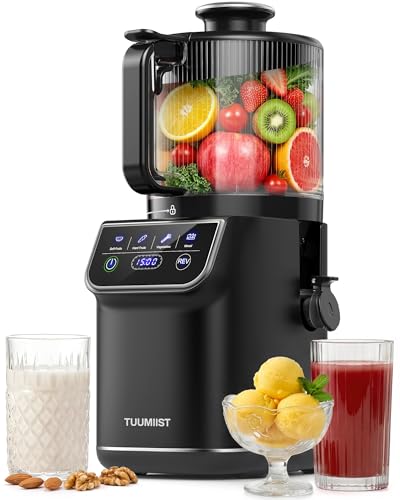
TUUMIIST’s smart-touch variant pushes the 3-in-1 concept further with a sealed control panel and a 100oz hopper. The wide 6.5″ chute still handles whole produce, while the touch interface replaces guesswork with a clean preset system. It feels more like a small kitchen appliance from 2026 and less like a legacy slow juicer.
For a household making multiple glasses in a row, the larger hopper means fewer pauses to reload. The trade-off is a step up in counter presence compared to the smaller Anybear 200W model.
Good Reasons To Consider
- Smart-touch controls simplify switching between juice, milk, and sorbet.
- 100oz hopper handles batch prep without constant refilling.
- 6.5″ chute accepts whole fruits, similar to the standard TUUMIIST 3-in-1.
- Sealed panel is easier to wipe down than mechanical dials.
What To Weigh
- Touch controls require more care around moisture and splashes.
- Larger hopper means a slightly bigger footprint than compact rivals.
Feature Card
Best Suited To
Tech-forward home cooks who batch-prep juices and want a more automated workflow.
Where Another Pick Suits Better
The Anybear 350W Cold Press Juicer is a cleaner match for shoppers who prefer tactile dials over touch panels.
Anybear’s 350W model is the brand’s most performance-driven option in this roundup. A dual-stage auger (a two-pass crushing system) squeezes more liquid out of every carrot and bunch of kale, which matters if your daily glass leans heavy on greens. The 230Nm torque motor also keeps things moving through fibrous produce without bogging down.
Compared to the Anybear 200W earlier in this list, the 4.9″ chute and stronger motor add noticeable speed. The sound profile stays modest, especially next to a centrifugal machine like the Breville BJE200XL.
Well-Handled Touches
- Dual-stage auger improves yield on leafy greens and roots.
- 230Nm torque handles tough produce without stalling.
- Quieter operation than typical centrifugal juicers.
- 4.9″ chute is wider than the 200W model’s 4.3″ opening.
Softer Spots
- Higher power draw may be noticeable on shared kitchen circuits.
- Larger motor adds a bit of weight compared to ultra-light picks.
Who Should Grab It
Daily green-juice drinkers who want maximum yield without moving to a full-size machine.
Not Your Match When
The Anybear 200W fits occasional juicers who don’t need the extra torque or dual-stage system.
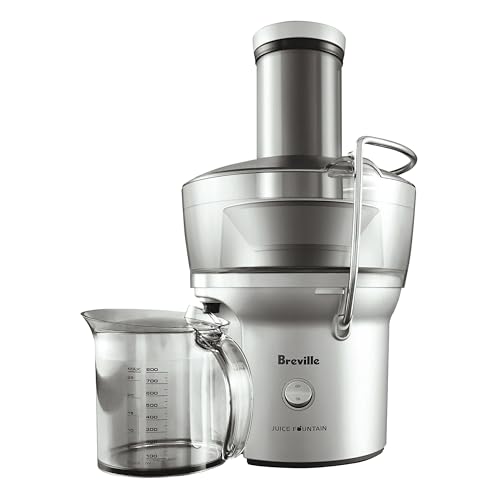
The Breville BJE200XL takes a different approach than every other pick on this list. It’s a centrifugal juicer, meaning a high-speed spinning disc shreds produce and flings juice through a fine mesh, rather than slowly pressing it. That design produces a glass in seconds, which suits hard produce like carrots, beets, and apples.
The titanium-reinforced disc and 3″ chute keep things efficient, while the integrated pulp container saves counter space. Leafy greens are where it shows limits, since a fast spin doesn’t extract as cleanly as a slow auger. For shoppers who prefer speed and a familiar appliance brand, that trade-off often feels fair.
Positive Takeaways
- Centrifugal speed turns hard produce into juice in seconds.
- Titanium-reinforced cutting disc supports long-term durability.
- 3″ chute accepts whole apples and similar fruits.
- Internal pulp bin keeps the full footprint self-contained.
Points To Note
- Higher noise level than slow-press rivals like the Nama J3.
- Less efficient on leafy greens than masticating models.
- Faster oxidation means juice is best enjoyed right away.
Feature Card
Built With In Mind
Home cooks who prioritize speed, durability, and a recognizable appliance brand for hard-fruit juicing.
A Better Fit Elsewhere
The TUUMIIST 3-in-1 Cold Press Juicer is a stronger match for shoppers who mostly juice leafy greens.
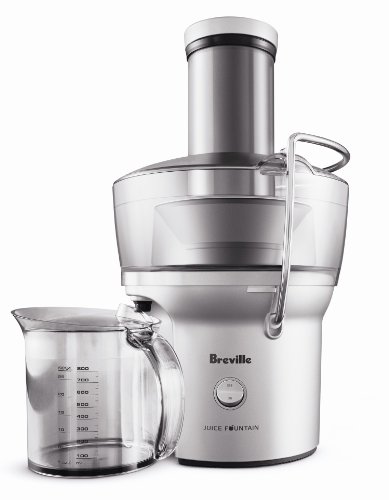
The standard Breville Juice Fountain Compact is essentially the BJE200XL’s sibling in spirit, trimmed to the smallest practical centrifugal footprint. It uses the same titanium-reinforced extraction system and 3″ chute, but lands at a size that fits even the tightest studio counter.
For shoppers who like the Breville ecosystem but don’t need the slightly larger BJE200XL, this compact version keeps the core experience intact. Leafy greens are still the weak spot, but for apple, carrot, and citrus-heavy routines, the output is solid.
The Case For It
- One of the smallest centrifugal juicers in this roundup.
- Titanium-reinforced disc mirrors the BJE200XL build quality.
- 3″ chute fits whole apples and standard produce.
- Internal pulp bin keeps the footprint tidy.
Some Limits To Know
- Centrifugal design is louder than the Anybear slow-press options.
- Less effective on fibrous greens than masticating picks.
Whose Shelf It Belongs On
Dorm residents, studio dwellers, and minimal-counter households who want fast, small-batch juicing.
Swap It Out When
The Anybear 200W fits shoppers who juice a lot of greens and prefer a quieter slow press.
The 200W Anybear with a 4.3″ chute is a straightforward entry point into cold-press juicing. It runs at around 65 RPM, which keeps the motor quiet enough for early-morning use without waking the household. The included recipe guide is a small perk that helps new owners actually start using the machine rather than letting it collect dust.
Compared to the larger Anybear 350W, this one trades speed for accessibility. For a first juicer in a small kitchen, that trade often makes sense.
A Favorable Mix
- Low 65 RPM operation keeps noise and heat down.
- Recipe guide supports beginners building a juicing habit.
- BPA-free build addresses food-safety concerns.
- Compact body fits smaller countertops and shelves.
Worth Bearing In Mind
- 4.3″ chute means more prep than the TUUMIIST 5.8″ model.
- 200W motor works best with softer produce and smaller batches.
The Right Fit
First-time cold-press owners who want a simple, guided introduction at an accessible price.
Where A Sibling Pick Shines
The TUUMIIST Cold Press Juicer 5.8″ is a stronger match for households wanting wider chute convenience.
The Hurom H320 is the most refined option in this list. A control lever plus fine and coarse strainers let you tune pulp levels from clear to pulpy, which is unusual at this size. The self-feeding hopper and quiet motor make it feel like a small appliance designed to stay on the counter, not get packed away.
For multi-glass routines, the family-size opening and inlet mean you can top up produce without stopping the machine. That kind of workflow is what separates a premium slow press from entry-level units like the Anybear 200W.
Reasons It Performs
- Adjustable strainers give control over pulp texture.
- Self-feeding hopper supports hands-free top-ups mid-run.
- Quiet motor is among the least intrusive in this roundup.
- Family-size opening accepts whole produce without constant stopping.
- Easy-assembly design simplifies daily setup and cleanup.
Trade-Offs To Consider
- Premium positioning is reflected in the price tier.
- Larger opening means more visible produce staging on the counter.
Feature Card
Who It Suits Best
Multi-glass daily users who want a quiet, tunable slow press and don’t mind paying for refinement.
Another Choice May Suit
The Anybear 350W fits shoppers who want strong performance at a more modest price tier.
What Matters Most Before Choosing Small Juicers
The category splits into two main types. Centrifugal juicers like the Breville BJE200XL spin a blade-disc at high speed to fling juice through a mesh, producing a glass fast but running louder and oxidizing juice more quickly. Masticating (slow-press) juicers, including every Nama, Anybear, TUUMIIST, and Hurom on this list, use a slow-turning auger that crushes and squeezes produce at low RPM. Slow-press machines run quieter, extract drier pulp, and preserve more nutrients, though they take longer per glass.
Chute width is the next practical lever. A 3″ chute fits whole apples but asks you to halve larger items. Chutes between 4.3″ and 5.8″ handle most produce with light prep. Anything 6.5″ or wider genuinely accepts whole apples, celery stalks, and similar items without chopping.
Footprint And Storage
Compact bodies like the Nama J3 and the Breville Juice Fountain Compact fit beside a coffee maker without reorganizing the counter. Wider 3-in-1 units like the TUUMIIST 3-in-1 are still “small” by full-size standards, but they need a dedicated corner. For apartments, RV kitchens, or shared counters, footprint often matters more than yield.
Yield And Auger Design
Dual-stage augers, like the one in the Anybear 350W, press produce twice for drier pulp and higher output. Single-stage augers handle most produce fine but leave a bit more moisture behind. Leafy greens are where the difference shows most.
Power, Noise, And Daily Routine
A 200W motor covers soft produce and small batches comfortably. A 350W motor handles tough roots and large batches with less effort. Centrifugal machines produce more noise by nature, while slow-press units typically run at conversational volume.
Key Considerations Across These Picks
Pitfalls Shoppers Hit
A common trap is choosing a centrifugal juicer for leafy greens. The fast spin doesn’t grab moisture from kale or spinach efficiently, leaving the pulp wet and the glass thin. A second slip is overlooking chute size: a 3″ opening sounds fine until you face a pile of whole apples at 7 a.m. The third is underestimating noise. Centrifugal machines register in the kitchen in a way slow-press picks do not, which matters in open-plan homes.
When Paying More Pays Off
The premium tier, including the Hurom H320 and the TUUMIIST Smart Touch, buys quieter operation, dual-stage extraction, multi-function strainers, and larger hoppers. For daily multi-glass routines, those gains show up immediately. For occasional weekend juicing, the entry-level Anybear or Breville compact models deliver most of the experience at a noticeably smaller cost.
Frequently Asked Questions
Are small juicers as powerful as full-size machines?
Small juicers use the same core technologies as full-size models, including slow augers and centrifugal discs, but in tighter housings. A well-designed compact like the Anybear 350W can match mid-size output. The difference shows up more in hopper size and batch speed than in raw extraction quality.
How loud are slow-press juicers?
Slow-press juicers run at low RPM, often between 40 and 80, which keeps noise close to a quiet conversation. Centrifugal machines like the Breville BJE200XL run noticeably louder, comparable to a blender at high speed.
Can I leave juice in the fridge overnight?
Slow-press juice holds up better overnight than centrifugal juice, thanks to lower oxidation, but both are freshest within 24 hours. Storing in a sealed glass container helps preserve color and flavor either way.
Is cleanup hard on these machines?
Most picks on this list, including the TUUMIIST, Anybear, and Nama models, disassemble in a few steps and rinse under the tap. Strainer meshes benefit from the included cleaning brush, which is a small detail that saves real time.
Do I need a wide chute?
Wider chutes save prep time but aren’t strictly necessary. A 3″ or 4.3″ chute asks for quick halving, while a 6.5″ chute accepts whole produce. The right choice depends on how many minutes you want to spend with a cutting board each morning.
Closing Remarks
The right small juicer depends on how often you plan to use it and what you intend to feed it. Daily green-drinkers benefit from the Anybear 350W or Hurom H320. Mixed-produce households gravitate toward the TUUMIIST 3-in-1 or the wide-chute TUUMIIST 5.8″ model. Tight-counter shoppers will appreciate the Nama J3 or either Breville compact. Match the machine to your real morning, and the routine sticks.



