

A solid PC mixer does more than shuffle audio between sources. It shapes how cleanly your mic captures vocals, how smoothly a livestream stays balanced, and how confidently a small studio can run a session without constant rework. With inputs, preamp quality, software bundles, and on-board effects all varying widely, the right pick depends on what you’re actually recording or broadcasting. The lineup below covers streamers, podcasters, home musicians, and DJs, so you can match the hardware to your real workflow instead of guessing from a spec sheet.
Your Options, Compared

M-Audio M-Track Duo USB Audio Interface and BX3 Speakers Bundle

Arturia MiniFuse USB Audio & MIDI Interface, MiniFuse 2

TC-Helicon GoXLR Broadcaster Platform 4-Channel Mixer

Audient iD14 MKII USB-C Audio Interface (Black)

Pioneer DJ DJM-250MK2 2-Channel DJ Mixer (Black)
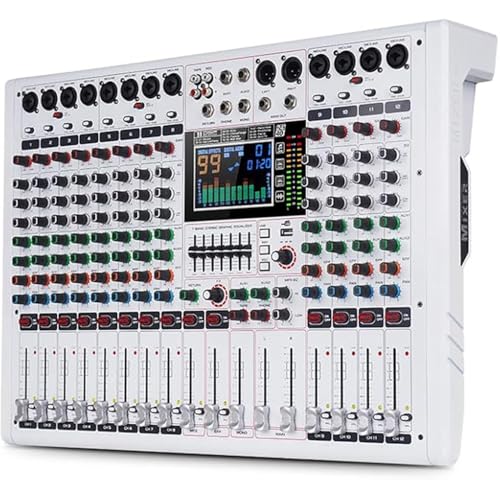
GF12 PRO 12-Channel Stage Performance Audio Mixer

KENBAIDIO 4-Channel Digital DJ Mixer with Bluetooth

Depusheng PA6 6-Channel DJ Audio Mixer with Bluetooth
A Deeper Look At The Lineup
Setting up a first home studio usually means buying an interface, a pair of monitors, and a cable kit, then wondering if anything will actually talk to your PC. The M-Track Duo USB Audio Interface and BX3 Speakers Bundle answers that problem in one box, pairing a dual-input audio interface with a set of 120-watt powered monitors so you can plug in and start tracking the same afternoon.
The interface accepts two combo XLR (the round three-pin connector used by most pro microphones), line, or instrument signals at once, which means a vocalist and a guitar player can record simultaneously without buying extra gear. Phantom power (the +48V electrical current that condenser microphones need to operate) is available for studio condensers, and a USB/Direct switch lets you monitor with near-zero latency. If your room doubles as a bedroom and your gear has to earn its shelf space, this kit trims the setup time way down.
Practical Pluses
- Two simultaneous inputs let a singer and an instrumentalist record at the same time
- Built-in phantom power supports condenser microphones out of the box
- 120W powered speakers remove the need to buy separate studio monitors
- Dedicated 1/4-inch headphone output keeps private monitoring simple
- USB/Direct switch helps avoid the lag that throws off live performers
Points To Note
- Only two inputs may feel tight once a small drum kit or full band enters the picture
- Powered speakers need desk space and decent cable management behind them
- Owners of small apartments commonly report needing to tame the bass response at low volumes
Right Fit For
Singers, streamers, and podcasters building a first PC-based setup who want monitors and an interface in a single purchase.
Swap It Out When
Step up to the Audient iD14 MKII USB-C Audio Interface (Black) when cleaner preamps and expandable I/O matter more than bundled speakers.
Not every PC setup has room for a half-rack interface, and not every producer wants to lug a chunky box to a hotel room. The Arturia MiniFuse 2 is built for that exact scenario, shrinking a competent two-input interface down to something you can drop in a backpack alongside a laptop. It also covers MIDI, the old-school digital language that lets keyboards and drum machines talk to your DAW (Digital Audio Workstation, the recording software on your computer).
Where bulkier interfaces use full-size XLR jacks, the MiniFuse 2 trims the chassis without trimming the essentials, including a 5-year manufacturer warranty. If you record in a small apartment, a dorm, or a tour-bunk setup, the size-to-capability ratio is hard to beat. Compared with the M-Audio bundle above, you lose the monitors but gain serious portability and MIDI support.
Useful Touches
- Compact form factor slips into a laptop bag for mobile sessions
- MIDI I/O opens the door to hardware synths and drum machines
- 5-year warranty is unusually long for an interface in this class
- USB-C connection means fewer dongles on modern laptops
Trade Offs
- Only two inputs, so multi-mic sessions are out
- No bundled monitors, which raises the total cost for studio use
Key Attributes
Best Suited To
Bedroom producers and traveling songwriters who care more about portability than channel count.
Reach For A Different Pick When
The TC-Helicon GoXLR Broadcaster Platform 4-Channel Mixer fits better for streamers running game chat, music, and a mic at the same time.
Streaming audio gets messy fast, with game sound, Discord chat, music, and a mic all competing for the same mix. The TC-Helicon GoXLR is built specifically for that headache, packing a four-channel mixer, motorized faders (slider knobs that physically move to match your on-screen levels), vocal effects, and a sound board into a single Windows-supported unit.
The motorized faders are the headline trick: when you switch scenes in OBS (Open Broadcaster Software, the app most streamers use to go live), the faders glide to match, so on-screen audio levels always match reality. Sample playback and vocal processing live on the hardware, which keeps your streaming PC focused on frames per second rather than effects chains. For full-time creators, that consolidation alone justifies the desk space.
What Helps Most
- Motorized faders keep physical and digital mix states in sync
- Built-in vocal effects reduce the need for extra plugins
- Sample trigger pads let you fire sound effects mid-stream without alt-tabbing
- Four dedicated channels cover mic, game, music, and chat separately
Honest Caveats
- Officially Windows-only, so macOS users need a different route
- Takes up significant desk real estate compared to compact interfaces
- Onboard effects are fun, but professional vocalists may want more surgical plugins
Who Will Love This
Full-time Twitch and YouTube broadcasters who manage multiple audio sources in every stream.
Not Your Match When
Pick the Pioneer DJ DJM-250MK2 2-Channel DJ Mixer (Black) if your real goal is mixing music between decks, not balancing a live stream.
Home recordists tend to hit a ceiling where budget interfaces start coloring their vocals in unflattering ways. The Audient iD14 MKII exists to break through that ceiling, putting Class-A microphone preamps (a specific circuit design prized for clean, musical gain) borrowed from Audient’s high-end ASP8024 HE console into a desktop USB-C box.
Two headphone outputs mean you and a co-producer can monitor at the same time, and the monitor mix and panning function lets you dial in a custom blend between input and playback. The metal chassis feels substantial on the desk, a step up from the plastic shells common at this category. Compared with the MiniFuse 2, the iD14 MKII trades portability for noticeably better preamp performance and expandability through ADAT (a digital protocol that lets you add more inputs later via an external preamp box).
The Case For It
- Class-A console-derived preamps deliver clean, detailed vocal capture
- Two independent headphone outs simplify collaborative sessions
- USB-C keeps cable clutter low on modern workstations
- Monitor mix panning helps artists find a comfortable balance while tracking
Possible Compromises
- Higher cost than entry-level interfaces with similar channel counts
- No included software bundle beyond what’s needed for setup
Core Details
Perfect Match For
Home recordists and singer-songwriters chasing near-studio preamp quality without a rack of outboard gear.
A Better Fit Elsewhere
Choose the M-Audio M-Track Duo USB Audio Interface and BX3 Speakers Bundle if you also need speakers and a mic cable to get started.
DJs shopping for a first “real” mixer usually land on the Pioneer DJ DJM-250MK2, and for good reason. It borrows the Magvel crossfader (Pioneer’s smooth, durable fader design originally built for scratch performance) from the club-standard DJM-900NXS2, so beginners get the same kind of tactile feel pros rely on.
Dedicated 3-band isolators (EQ knobs that let you cut bass, mid, or treble all the way to zero) make it easy to carve out space for a transition, while the Sound Color FX filter adds hands-on flair without menu diving. Dithering technology (a method of rounding digital audio to reduce distortion) keeps the signal warm whether you feed it analog or digital sources. For bedroom DJs practicing on a smaller controller, this mixer feels like a step up in build quality without jumping into club-tier pricing.
What Pays Off
- Magvel crossfader feels pro-grade for scratching and cuts
- 3-band isolators give precise control over bass, mids, and highs
- Dithering tech keeps audio clean from both analog and digital feeds
- Layout mirrors Pioneer’s club mixers, easing the upgrade path later
Things To Weigh
- Only two channels, so multi-deck or four-source sets aren’t possible
- Requires separate media players or turntables to form a complete rig
- No built-in audio interface for direct recording into a PC, depending on configuration
Right Fit For
Beginner and intermediate DJs practicing at home or playing small venues who want a real club-style feel.
Where Another Pick Suits Better
Pick the Depusheng PA6 6-Channel DJ Audio Mixer with Bluetooth if you need more inputs and onboard effects for small live bands.
Bigger stages need bigger mixers, and the GF12 PRO brings 12 channels to a price tier usually reserved for 4 or 6-channel boards. Each channel gets its own gain trim, EQ, and send controls, so the front-of-house engineer can shape vocals, drums, keys, and playback without fighting anyone else’s settings.
A 7-stage equalizer covers deep tone shaping for the main mix, and 99 built-in reverb effects cover most vocal sweetening you’ll need for a live show. A color LCD screen keeps the deeper menu navigation visible, which is genuinely helpful in a dark club. Compared with the Pioneer DJM-250MK2 above, the GF12 PRO trades DJ-specific flair for raw channel count and stage-oriented processing.
Strengths Worth Knowing
- 12 channels support a full band without sub-mixing
- 99 onboard reverb presets cover most vocal needs
- 7-stage main EQ gives precise room correction at the front of house
- Per-channel mute switches speed up troubleshooting mid-show
Less Ideal Details
- Bulkier than compact interfaces, so it needs a dedicated rack or stand
- Learning curve is steeper for users coming from two-channel gear
Spec Overview
Built With In Mind
Small-to-mid live venues, houses of worship, and stage performers who run full band setups through one board.
Skip It When
The KENBAIDIO 4-Channel Digital DJ Mixer with Bluetooth is a more sensible size for home karaoke or small podcast rigs.
Some setups want a mixer that doesn’t force a computer connection just to play a phone. The KENBAIDIO 4-Channel Digital DJ Mixer adds Bluetooth, USB, and MP3 inputs alongside standard XLR/line jacks, so a phone, a flash drive, a laptop, and a microphone can all feed the same mix.
The all-metal body feels sturdier than the price implies, and 99 DSP (Digital Signal Processing, the on-board digital effects engine) presets cover common vocal and instrument polish. 48V phantom power is included for condenser microphones, which is rare at this tier. The 7-band EQ handles room tuning without overcomplicating the front panel. For karaoke hosts and home podcasters mixing wireless playback, the input flexibility is the real draw.
Practical Advantages
- Bluetooth input cuts the cable for casual playback from a phone
- 48V phantom power supports condenser microphones
- 7-band EQ offers solid tonal control without menu diving
- USB and MP3 playback cover flash-drive and direct-digital sources
Smaller Caveats
- Only four channels limit full-band scenarios
- Bluetooth adds convenience but won’t match a wired connection for latency-sensitive music
Whose Shelf It Belongs On
Home karaoke hosts, small podcasters, and content creators who want flexible wireless and wired inputs at once.
Not Your Match When
Step up to the GF12 PRO 12-Channel Stage Performance Audio Mixer for full-band stage use.
The Depusheng PA6 sits in a useful middle ground, offering six channels plus a deep effects library for a price closer to four-channel competitors. 256 DSP presets go well beyond the usual reverb and delay, covering vocal thickening, instrument polish, and effect combinations that can save a small venue’s PA from sounding flat.
Bluetooth streaming and USB/MP3 playback are baked in, alongside 48V phantom power for studio condensers. Owners running small weddings, KTV rooms, or conference sessions can plug in a mic, a laptop, a phone, and a playback source without buying adapters. Compared with the KENBAIDIO above, the PA6 doubles the channel count and quadruples the effect presets, which matters once a small band enters the mix.
What Makes Sense
- Six inputs cover small bands, duos, and panel discussions
- 256 DSP presets offer deep on-board effects without extra gear
- Bluetooth plus USB covers both casual and pro playback sources
- 48V phantom power supports condenser microphones for vocal-heavy setups
Where It May Fall Short
- More channels and effects mean a steeper menu than four-channel boards
- Bluetooth latency can interfere with tight click-track work, depending on your device
Who Should Grab It
Small bands, mobile DJs, and KTV hosts who want channel count and effects in one transportable package.
Consider Something Else When
Choose the Audient iD14 MKII USB-C Audio Interface (Black) when studio recording clarity matters more than stage-oriented effects.
What Really Matters When Picking a PC Mixer
Inputs, Outputs, and Preamp Quality
The first question is what you actually need to plug in. A solo podcaster can live with one mic input, but a small band needs six or more channels. Preamps, the tiny amplifier circuits that boost a microphone’s faint signal to a usable level, vary more than people expect; cleaner preamps mean less hiss and more accurate vocal capture. The Audient iD14 MKII and the M-Track Duo both lean on stronger preamp design than the average budget board.
Software, Drivers, and Streaming Workflows
Some interfaces ship with bundled software, while others expect you to use your DAW of choice. Streamers should look for Windows support and routing software that can split mic, game, chat, and music cleanly. The GoXLR handles that role in hardware, while traditional interfaces usually pass the job to OBS or a virtual audio cable setup.
Build, Footprint, and On-Board Effects
A mixer that lives on a desk all year needs to feel solid, while a portable rig should be light and bus-powered. On-board effects, like the 99 to 256 DSP presets on the larger boards, can replace a rack of outboard gear for small venues, but they rarely beat well-chosen plugins for studio work.
Smart Buying Slip Ups and When To Spend More
Mistakes Worth Dodging
Buying a board with more channels than you’ll ever use just inflates the cost and the menu navigation. Conversely, picking a two-channel interface for a four-piece band means buying a second mixer within a year. Match the channel count to your real, current setup, and leave one or two inputs of headroom for growth.
Where The Extra Money Goes
Higher-tier models tend to spend the budget on preamp quality, build materials, and more flexible routing rather than flashy features. The Audient iD14 MKII’s Class-A preamps and the GoXLR’s motorized faders are good examples of money that goes into the actual audio path or workflow rather than a marketing claim. For most home users, that premium pays off when the gear stays in service for years rather than months.



