

A streaming setup that sounds thin or looks chaotic pulls viewers out of the moment fast. The right mixer solves both problems at once, giving you tactile control over audio levels and, for video rigs, the ability to cut between cameras without freezing on screen. This roundup covers hardware designed for live creators, from desktop audio mixers built around a single XLR mic to multi-camera video switchers that handle worship services, gaming tournaments, and remote podcasts. Each pick is matched to a specific kind of streaming workflow, so you spend less time guessing and more time going live.
A Closer Look At The Lineup

Behringer X32 40-Input Digital Mixing Console (Black)

Osee GoStream Deck HDMI Pro Live Streaming Mixer Switcher

Osee GoStream Duet SDI and HDMI Live Stream Video Mixer

RGBlink Mini-pro V3 4K HDMI Video Mixer Switcher with PTZ

TC-Helicon GoXLR 4-Channel Mixer with Motorized Faders

RGBlink mini-Edge SDI All-in-One Live Streaming Video Mixer
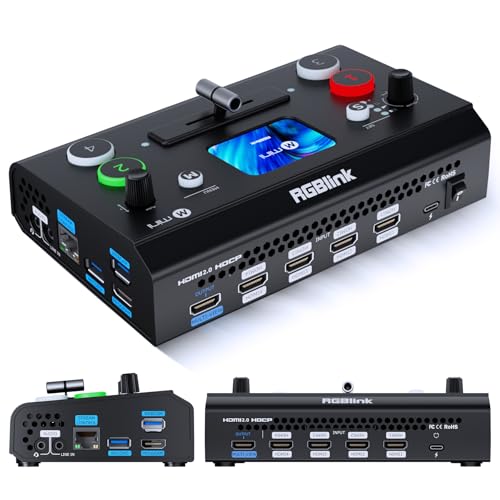
RGBlink Mini V3 4K HDMI Switcher with TAO Cloud Features

Osee GoStream Duet Kit All-in-One Live Streaming Video Mixer Kit
What Each Pick Brings To The Table
The Behringer X32 sits in a different league from the desktop streaming gear that follows, and that shows in everything from its 40-input architecture to its motorized fader bank. Built around 32 programmable MIDAS preamps, the console handles a full band, a panel of speakers, and a broadcast feed without breaking a sweat. Audio engineers running hybrid live-and-streamed events tend to favor it because the same desk can mix the room, send a clean stereo feed to the encoder, and route a separate monitor mix to the talent.
For most solo streamers the X32 is overkill, but for touring acts, houses of worship, and event production crews it’s a workhorse. The included iPad and iPhone remote app lets a second operator tweak channel strips from the audience, which is genuinely useful during a multi-act broadcast.
Notable Gains
- 32 programmable MIDAS preamps cover a full multi-mic rig without outboard preamps
- 25 motorized faders respond to scene recall, so saved mixes snap back instantly during a stream
- Built-in 32-channel audio interface streams a multitrack feed straight to a DAW (digital audio workstation) for post-show editing
- iPad and iPhone remote control frees a second tech to roam the venue
Points To Keep In Mind
- The footprint and weight demand a dedicated road case or permanent install
- Menu depth takes real time to learn; first sessions feel slower than a compact analog desk
Feature Snapshot
Who It Suits Best
Audio engineers, touring bands, and event production teams running a hybrid live-plus-stream broadcast from a single desk.
Reach For A Different Pick When
Solo creators on a single-mic Twitch or YouTube setup will find the TC-Helicon GoXLR a far more comfortable fit for a desktop streaming rig.
The Osee GoStream Deck fits creators who run four HDMI sources and want clean cuts without a software-defined workflow. Four HDMI inputs feed two HDMI outputs for program and multiview, while dual USB-C ports handle webcam passthrough, SSD recording, and a tethered computer. The Ethernet port pushes a stream directly via NDI HX (a low-latency network video protocol commonly used to move video between devices over standard IP networks) or RTMP (a streaming protocol most platforms accept), so the Deck can go live without a capture card in the loop.
Compared to the RGBlink Mini-pro V3 covered below, this one leans harder on NDI as a free firmware-updatable option. Solo creators juggling cameras, a laptop, and a gaming console will appreciate that everything talks over standard HDMI rather than a tangle of adapters.
What Helps Most
- Four HDMI inputs plus two HDMI outputs keep program and preview on separate feeds
- USB-C ports handle webcam, SSD recording, and host computer in one box
- NDI HX is a firmware option, so older units gain features without buying new hardware
- Headphone monitoring and dedicated audio inputs keep audio checks simple
Honest Caveats
- Full feature set needs the latest firmware, which can be a slow first-time install
- No SDI (a professional broadcast video connection using locking BNC connectors) inputs, so broadcast cameras require converters
Made For
Solo creators running two to four HDMI cameras who want a hardware switcher with NDI as an upgrade path.
Look Elsewhere When
Teams using professional SDI cameras should look at the Osee GoStream Duet, which accepts both SDI and HDMI in the same chassis.
The GoStream Duet is the more broadcast-friendly sibling of the Deck, mixing four SDI inputs with four HDMI inputs, plus USB-C, NDI HX, and SD or SSD playback. That input blend is the reason houses of worship and small broadcast studios reach for it: a locked SDI feed from the sanctuary camera and an HDMI feed from a confidence monitor can land on the same switcher without juggling adapters.
It also handles landscape and portrait output, which matters if you’re producing vertical streams for social platforms. Control runs through the built-in GUI (graphical interface), the Osee desktop app, or Bitfocus Companion, a third-party stream deck emulator that adds tactile macro control.
Standout Benefits
- Four SDI and four HDMI inputs in one chassis, alongside USB-C and NDI HX
- Portrait and landscape output support modern social streaming formats
- Chroma key (green-screen removal), luma key, and multisource layering unlock more dynamic shows
- Bitfocus Companion integration adds physical-button macro control
Less Ideal Details
- Total input count means a larger desk footprint than compact HDMI-only switchers
- Chroma key quality takes scene tuning before it looks natural on stream
Quick Facts
Best Suited To
Worship production teams and small broadcast studios blending locked SDI cameras with consumer HDMI sources on the same show.
Not Your Match When
Traveling solo creators will find the heavier Osee GoStream Duet Kit a more practical bundle than the standalone Duet chassis.
The RGBlink Mini-pro V3 adds 4K capability to the Mini line, with four HDMI 2.0 inputs accepting 4K sources and dual HDMI outputs for program plus multiview. A USB 3.0 output feeds a connected computer, and a built-in 2.1-inch screen previews sources without an external monitor. The integrated PTZ (pan, tilt, zoom) controller speaks to compatible cameras directly, so a single operator can switch angles and steer remote heads from one surface.
Streaming output runs to up to four platforms at once over RTMP via Ethernet, which is the kind of bandwidth efficiency that matters for gaming tournaments and worship services with overflow rooms. It’s noticeably more capable than the standard Mini V3, and the trade-off is cost and a slightly busier learning curve.
Everyday Perks
- Four 4K HDMI inputs accept modern cameras and computers without downscaling
- Built-in PTZ control removes the need for a separate joystick controller
- Multistream to four platforms over RTMP via Ethernet saves extra encoders
- USB 3.0 output ties neatly into a streaming PC for software-based workflows
Things To Consider
- PTZ control requires RGBlink-compatible cameras or compatible serial protocols
- Full 4K pipeline demands 4K-capable cameras and monitors to see the benefit
Perfect Match For
Worship production teams, gaming tournament crews, and event operators running a compact 4K multi-cam rig from a single rack shelf.
Swap It Out When
Creators who want a built-in preview screen and SDI compatibility will be happier with the larger RGBlink mini-Edge SDI.
The TC-Helicon GoXLR is the audio mixer that defined the desktop streaming category, and it still earns its place on a Twitch desk. Four motorized faders handle mic, game, music, and chat on physical sliders, and the dedicated soundboard fires samples and meme clips mid-stream. The vocal effects engine, also from TC-Helicon, layers reverb, pitch shift, and EQ (equalization, the set of tone controls that shape how a voice sounds) directly on the hardware, so a streamer’s voice sits forward without taxing the streaming PC.
The honest read is that the GoXLR is a Windows-only tool with no native macOS support, and that limits who can use it. Where it fits, the experience is genuinely faster than juggling audio software mid-stream.
What Pays Off
- Four motorized faders make on-the-fly mix changes feel like a radio console
- Built-in vocal effects process audio on the hardware, not the streaming PC
- Programmable soundboard pads launch samples and memes without alt-tabbing
- Single USB connection keeps the desk clean and cable-managed
Trade Offs
- Officially supported on Windows only; macOS users need a different route
- Single mic input limits multi-mic podcast setups without a separate interface
The Right Fit
Solo Twitch and YouTube streamers on Windows who want tactile audio control, vocal effects, and a soundboard in one box.
A Better Fit Elsewhere
Multi-mic podcast teams or Mac-based creators will find more headroom with the Behringer X32 or a dedicated audio interface setup.
The RGBlink mini-Edge SDI is the largest unit in the Mini lineup, and the larger 5.5-inch screen is what makes it stand out for podcast and content studio use. The display gives operators a clean multiview without an external monitor, which trims the rack by one screen. Four 4K HDMI inputs sit alongside four 3G SDI inputs, plus UVC (USB Video Class, a standard for sending webcam video over USB), NDI HX2, line in, and mic in.
The on-board PTZ control, NDI support, and 8-channel audio mixer give it real range. It’s a step up from the Mini-pro V3, primarily because the integrated preview screen and SDI counts make it a true all-in-one, assuming a permanent studio setup.
Benefits That Matter
- Four HDMI and four SDI inputs support both consumer and broadcast cameras in one unit
- Built-in 5.5-inch preview screen removes the need for an external monitor on small rigs
- Eight-channel audio mixer handles a multi-mic podcast without extra gear
- NDI HX2 and UVC support mean networked and USB sources join the same production
Small Caveats
- Larger chassis than the Mini-pro V3, so it demands more desk or rack space
- Full feature set may require a firmware update on first boot, which takes planning
Feature Card
Whose Shelf It Belongs On
Multi-camera podcast studios and content creation rooms that want SDI inputs, NDI, and a built-in preview on a single shelf.
Where A Sibling Pick Shines
Traveling streamers and on-location crews will get more value from the Osee GoStream Duet Kit, which bundles a 14-inch monitor for a portable rig.
The Mini V3 is RGBlink’s pay-as-you-go approach to a streaming switcher, where the base hardware handles basic 4K switching and TAO Cloud unlocks extras as you need them. The 2.1-inch touch screen handles source selection, dual HDMI outputs feed program and preview, and PTZ control, recording, chroma key, and logo overlay all become available through monthly or lifetime cloud plans.
For growing creators, that structure matters: the entry unit doesn’t lock you out of professional features, but it also doesn’t force you to pay for everything on day one. Compared to the Osee GoStream Deck, the Mini V3 leans on a subscription model rather than free firmware updates for new features.
What Works In Its Favor
- Base unit handles 4K switching and dual HDMI output without a paid plan
- TAO Cloud plans unlock PTZ, recording, chroma key, and logo overlay individually
- 2.1-inch touch screen simplifies source selection without a laptop
- Modular pricing fits creators who don’t need every feature on day one
Some Limits To Know
- Advanced features stack as paid plans, so total cost grows over time
- Cloud activation requires a wired Ethernet connection and the latest firmware before use
Who Should Grab It
Growing creators who want a 4K-capable switcher today and the option to add features as the channel grows.
Skip It When
Creators who want all features included up front will be happier with the all-in-one RGBlink mini-Edge SDI.
The Osee GoStream Duet Kit wraps the Duet switcher into a portable bundle: a 14-inch 1080p monitor, a silent cooling fan, and three cheese plates with quarter-inch and three-eighths threads for rigging. The whole kit weighs roughly 5 kilograms, which makes it realistic to throw in a pelican case for an event job. NDI is activated out of the box rather than behind a paid tier, and the monitor pulls power through a built-in DC-to-Type-C cable, so the cable count stays manageable on a single cart.
Where the standalone Duet is a fixed-studio purchase, this kit leans into on-location work. For solo mobile streamers and event crews, the convenience of the bundled monitor alone saves an afternoon of rigging.
Practical Pluses
- 14-inch 1080p monitor and silent fan ship in the box, removing accessory shopping
- Roughly 5 kg total weight fits a mobile production cart or carry case
- NDI is free and activated, no extra purchase or subscription needed
- Cheese plates with quarter-inch and three-eighths threads rig to common accessories
Worth Bearing In Mind
- Mobile bundles cost more than a bare switcher, even if you already own a monitor
- Monitor ships portrait-friendly, so you may need to reorient stands for landscape work
Built With In Mind
Mobile streamers, on-location podcast teams, and event crews who want a single carry case that opens into a working production rig.
Consider Something Else When
Fixed studio installations with their own monitor stack will find the bare Osee GoStream Duet a more cost-effective choice.
What To Weigh Before Picking A Streaming Mixer
Audio-only mixers and video switchers solve different problems, so the first honest question is which side of your stream needs the most help. Audio-only rigs, like the TC-Helicon GoXLR, give you tactile control over mic, game, and chat levels without touching software. Video switchers, like the Osee and RGBlink family, exist to cut between cameras, layer graphics, and push a clean feed to your platform. Some setups benefit from both, but buying two boxes when one will do is a common trap.
For audio, XLR microphone support matters more than the number of faders on the surface. A single high-quality XLR input with phantom power (a 48V supply that powers condenser microphones through the same cable that carries audio) is more useful than eight line-level inputs you’ll never use. Vocal effects, EQ, and noise gates belong on the mixer when the streaming PC is already loaded, and they belong in software when you want to swap voices without re-routing hardware.
For video, count your real camera sources and add a margin for the next camera you will inevitably buy. HDMI-only switchers are fine for gaming and creator setups. Houses of worship, schools, and event crews should pick up SDI (Serial Digital Interface, a broadcast-grade video connection that locks in place and runs over long cable runs) early to avoid adapter piles. PTZ (pan, tilt, zoom) camera support matters the moment your operator can’t physically reach every camera, and built-in PTZ control saves a joystick and a patch cable.
Connectivity is the second honest question. Streaming over RTMP (Real-Time Messaging Protocol, the streaming standard most live platforms accept) via Ethernet keeps the load off your gaming PC, while USB output routes the feed through software for overlays and alerts. NDI HX support gives you network video without dedicated capture cards, which is a quiet long-term saver in any growing studio. Decide which outputs you need before reading spec sheets, because every extra output has a real reason to exist.
Key Things That Separate These Picks
Pitfalls Worth Dodging
Buying a switcher with more inputs than you’ll actually use wastes budget and rack space. A four-camera limit becomes real once you start adding tally lights, monitor feeds, and a backup camera. Match the input count to the show you’ll run in three months, not the dream show you’ll run someday.
Ignoring firmware costs real time on the first show day. Several units in this roundup, including the Osee GoStream Deck and the RGBlink Mini V3, need the latest firmware before advanced features work. Plan an afternoon for that update before any paid gig.
What The Higher Tier Buys You
The jump from a four-input HDMI switcher to a hybrid SDI/HDMI unit like the Osee GoStream Duet is real: longer cable runs, locked broadcast connections, and more reliable signal integrity on stage. The jump from a desktop audio mixer to a console like the Behringer X32 buys a full multitrack feed, scene recall, and remote control from a tablet. Both are paid back in saved setup time, not just audio or video quality, and that’s the real case for stretching the budget once your stream becomes a recurring production.
Frequently Asked Questions
Do I need an audio mixer and a video switcher?
You need whichever one solves your current problem. Single-mic streamers usually start with an audio mixer like the GoXLR, while multi-camera events need a video switcher like the Osee Duet or the RGBlink Mini-pro V3. Some productions use both, but that’s a scale question, not a starting point.
What is the difference between HDMI and SDI inputs on a streaming switcher?
HDMI is the common consumer and creator connector, while SDI is a professional broadcast connector with locking BNC (Bayonet Neill-Concelman, a threaded locking RF connector used in broadcast video) fittings and reliable long cable runs. SDI handles longer distances and stays locked during a live show, which is why event and worship crews prefer it.
How many camera inputs do I actually need for streaming?
Most solo creators run well on two to four inputs. A two-cam interview, a three-cam podcast, and a four-cam worship service are the common shapes. Pick the count that matches the show you’ll run this season, with one input of headroom for growth.
Will any of these work with my existing streaming software?
The video switchers in this list push feeds over USB, HDMI, or NDI, which most streaming software accepts, including OBS, vMix, and Wirecast. The GoXLR is officially Windows-only, so macOS users need to plan around that limitation.
Can a small switcher handle a multi-platform live stream?
Yes. The RGBlink Mini-pro V3 streams to four platforms simultaneously over RTMP via Ethernet, and the Osee GoStream Deck uses NDI HX plus a computer route. Multistreaming on a small box works best when the network and upload bandwidth can carry the load across destinations.



