

A good hand mixer quietly becomes the most-used tool in a baker’s drawer. Between folding egg whites, creaming butter, and dragging a thick cookie dough together, the right motor and the right beaters save your wrist and shorten every recipe. The wrong one stalls, splatters, or buries its attachments in a junk drawer.
This lineup focuses on handheld mixers that handle real baking workloads, not just a quick scramble. Every pick earns its spot through speed range, attachment versatility, motor strength, or a mix of all three. The notes below reflect what each model is genuinely built to do, and which bakers will feel the difference most.
Your Options, Compared

KitchenAid 6 Speed Hand Mixer KHM6118 (Contour Silver)

KitchenAid 5-Speed Ultra Power Hand Mixer (White)
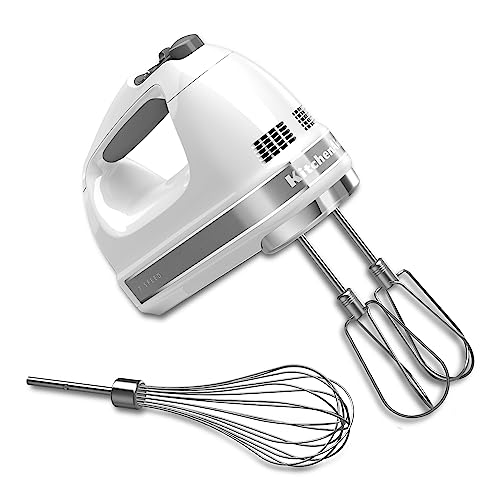
KitchenAid 7 Speed Hand Mixer KHM7210 (White)

KitchenAid 9 Speed Hand Mixer KHM926 (Candy Apple Red)

Hamilton Beach 6-Speed Hand Mixer with QuickBurst

Lord Eagle 400W 5-Speed Hand Mixer with Storage Case

Cuisinart 9-Speed Hand Mixer with Long Beaters

Oster 2109597 7-Speed 250W Classic Hand Mixer
The Strengths Of Each Pick
The KHM6118 leans into a single clever upgrade: the Flex Edge Beaters, which carry a flexible silicone scraper along the side of each metal blade. In practice, that means less stopping to drag batter off the bowl walls with a spatula, which is the small frustration that adds up across a dozen cookies.
Six speeds cover the everyday baking range, from a slow first gear that folds chips into thick dough without throwing them across the bowl, to a top speed that pulls egg whites into soft peaks. The body is light enough for long creaming sessions, and the eject button keeps beater swaps quick during a multi-step recipe.
Key Advantages
- Flex Edge Beaters wipe bowl sides as they spin, cutting down on spatula pauses
- Six-speed range handles folding at speed 1 through whipped cream at speed 6
- Lightweight body reduces wrist fatigue during extended mixing
- One-touch beater ejection speeds up recipe transitions
Things To Consider
- No dedicated dough hooks, so sticky bread dough is outside its comfort zone
- No storage case included, so beaters tend to drift around a drawer
Feature Snapshot
Who It Suits Best
Home bakers who churn out cookies, brownies, and quick breads and want a clean bowl without the constant spatula break.
Consider Something Else When
Bakers making yeasted loaves regularly should look at the KitchenAid 9 Speed Hand Mixer KHM926, which ships with proper dough hooks.
The Ultra Power Hand Mixer trims back to the essentials: five speeds, two Turbo Beater accessories, and a body that feels balanced in the hand. It is the lighter, more approachable sibling of the KHM6118 above, aimed at bakers who mix a few times a month rather than every weekend.
Speed 1 is gentle enough to stir in chocolate chips, and speed 5 pulls cream into whipped peaks cleanly. The trade-off shows up when you push it into stiff cookie dough, where the motor’s smaller reserve becomes audible. For everyday cakes, pancake batter, and the occasional meringue, it stays comfortable.
The Good Stuff
- Simple five-speed layout is easy to learn for new bakers
- Turbo Beater attachments handle most standard batters well
- Light plastic-and-stainless build is easy to grip and store
- Lower cost than the KHM6118 while keeping core KitchenAid usability
Worth Noting
- Fewer speeds than the KHM6118, so very fine control is limited
- No dedicated whisk accessory, so meringue work takes longer
- Motor strains on very thick bread dough, which sits outside its real-world range
Right Fit For
Casual bakers who mostly handle box-mix upgrades, simple butter cakes, and light whipping.
Look Elsewhere When
Bakers who want a real whisk and more speed steps should step up to the KitchenAid 7 Speed Hand Mixer KHM7210.
The KHM7210 lands in the middle of the KitchenAid handheld family and quietly does the most. Seven speeds bridge the gap between the entry-level 5-speed and the dough-ready 9-speed, and the inclusion of a Pro Whisk sets it apart from the cheaper 5- and 6-speed options reviewed above.
You get the Stainless Steel Turbo Beater II accessories for heavier batters, plus a wire whisk that actually incorporates air into egg whites. For a baker who bakes weekly and likes to vary between cookies, cakes, and the occasional pavlova, this is the model that rarely feels under-equipped.
Everyday Advantages
- Seven speeds give finer control than the 5-speed Ultra Power
- Pro Whisk handles meringues and whipped cream without a separate tool
- Turbo Beater II accessories work well on thicker batters
- Stays compact enough for small kitchen drawers
Trade Offs
- No dough hooks, so yeasted bread dough falls outside the kit
- No storage case, so the beaters and whisk end up loose in a drawer
Best Suited To
Bakers who rotate between cookies, cakes, and airy meringues and want one tool that handles all three without a fuss.
Skip It When
Bread bakers kneading dough weekly should move up to the KitchenAid 9 Speed Hand Mixer KHM926, which adds dough hooks.
The KHM926 is the most complete kit in this roundup. It ships with the Stainless Steel Turbo Beater II accessories, a Pro Whisk, dough hooks, and a blending rod, which is a rare full set in the handheld category. Where the KHM7210 stops at batters and meringues, this one keeps going into yeasted dough.
Nine speeds give unusually fine control, from a barely-turning stir for chunky add-ins up to a top gear that pulls egg whites to stiff peaks quickly. The Candy Apple Red finish is a small touch, but in a kitchen where the mixer lives on the counter, the color actually matters.
A Few Strong Suits
- Full attachment set covers batters, meringue, dough, and blending
- Nine speeds allow precise control from gentle folding to stiff peaks
- Dough hooks open up small-batch bread and pizza dough
- Sturdy build feels stable in the hand during longer kneads
Honest Caveats
- Heavier than the 5- and 6-speed KitchenAid models, which can tire wrists
- More parts to keep track of, since every attachment needs a home
Feature Snapshot
Who Should Grab It
Bakers who want one hand mixer to cover cookies, cakes, meringues, and small bread doughs without swapping tools.
A Better Fit Elsewhere
Bakers who mainly make light batters and want easier cleanup should look at the Cuisinart 9-Speed Hand Mixer with extra-long beaters.
Hamilton Beach tackles the storage problem head-on. A snap-on case fits the attachments and the cord together, so the mixer stays a single tidy object instead of a beater graveyard in a drawer. For a small kitchen or a rental with limited cabinet space, that alone is a real reason to consider it.
Six speeds, a QuickBurst button for an extra hit of power when batters stall, and a built-in bowl rest round out a practical package. The slow first speed also helps with flour-heavy mixes, where a fast first spin tends to send a cloud of dry ingredients across the counter.
The Upside
- Snap-on storage case keeps attachments and cord together
- Bowl rest prevents drips on the counter during pauses
- QuickBurst button adds a power surge when batters need a push
- Slow first speed reduces flour clouds when starting batters
Points To Keep In Mind
- No dedicated dough hooks, so yeasted doughs are not its strength
- Plastic build feels lighter than the KitchenAid handhelds, which can feel less substantial
Feature Snapshot
Made For
Bakers working in small kitchens, apartments, or shared spaces where storage and cleanup matter as much as motor power.
Swap It Out When
Bakers wanting more attachment variety and a sturdier feel should look at the KitchenAid 9 Speed Hand Mixer KHM926.
Lord Eagle leans into value, bundling a 400-watt motor, five stainless steel attachments, and a storage case at a notably low cost. For a first kitchen or a starter baking kit, it is a genuinely tempting package, and the turbo button adds a quick power hit when cake batter resists the beaters.
The honest read is that this is a basic workhorse, not a refined tool. It handles cake batters, pancake mix, and small whipping jobs well, but very thick cookie doughs will tax the motor and expose its limits. Treat it as a budget learning tool and it will feel like a fair trade.
The Helpful Details
- Five stainless steel attachments cover most basic baking tasks
- Turbo button delivers an instant power boost for stubborn batters
- Storage case included, which is unusual at this price tier
- Lightweight body is easy for smaller hands to manage
Some Limits To Know
- Motor strains on dense bread dough, where higher-tier mixers stay calm
- Fewer speed steps than the 7- and 9-speed models above, so fine control is limited
- Brand recognition and long-term parts support are slimmer than the major-name picks
Who Will Love This
Beginners, students, and casual bakers who want a complete kit without committing to a higher price.
Reach For A Different Pick When
Bakers wanting stronger motor headroom for tougher doughs should look at the Oster 2109597 7-Speed 250W Classic Hand Mixer.
Cuisinart’s Power Advantage Plus tackles a problem most handhelds ignore: deep bowls. The extra-long beaters reach the bottom of a tall mixing bowl without forcing you to tilt the whole thing, which matters when doubling a cake recipe or working in a narrow stockpot.
Nine speeds pair with a SmoothStart feature that ramps in slowly through the first three settings, so flour and liquids do not jump out of the bowl on contact. The 220-watt motor sits behind an automatic feedback system that adjusts torque as the batter thickens, which helps on stiff cookie doughs.
Well-Handled Touches
- Extra-long beaters reach the bottom of deep mixing bowls
- SmoothStart ramps in slowly, reducing splatter at the beginning of a mix
- Automatic feedback adjusts power as batter thickens
- LED display shows the active speed clearly during use
A Few Limitations
- No dough hooks included, so yeasted dough is not part of its kit
- Heavier than the 5- and 6-speed picks, so long sessions can tire the wrist
Feature Snapshot
Perfect Match For
Bakers who work in deep bowls, frequently double recipes, or want the most refined speed control of the bunch.
Where A Sibling Pick Shines
Bakers focused on bread dough and a full attachment kit will find more in the KitchenAid 9 Speed Hand Mixer KHM926.
The Oster Classic Hand Mixer takes the no-nonsense route: a 250-watt motor, seven speeds, stainless steel beaters, dough hooks, and a Super Aerator Whisk, all in a familiar black body. For a family kitchen that bakes a bit of everything, it covers a wider workload than its price might suggest.
The Super Aerator Whisk is the small upgrade worth noticing. It pulls more air into egg whites and cream than a standard balloon whisk, so meringues come together faster and whipped cream holds its shape longer in the fridge.
Useful Strengths
- 250-watt motor handles denser batters better than lower-watt picks
- Super Aerator Whisk whips air into egg whites quickly
- Seven speeds cover folding through stiff peaks
- Dough hooks make small bread or pizza dough feasible
Where It Is Less Suited
- No storage case, so attachments end up loose in a drawer
- Plastic housing feels lighter than the metal-bodied KitchenAid 9-speed
Whose Shelf It Belongs On
Family bakers who make cookies, cakes, the occasional bread loaf, and the regular batch of whipped cream.
Not Your Match When
Bakers wanting the longest beater reach and SmoothStart control should look at the Cuisinart 9-Speed Hand Mixer with extra-long beaters.
What Actually Matters In A Baking Hand Mixer
Motor power matters, but it is not the only lever. Wattage tends to correlate with how the mixer handles stiff dough, though a well-balanced 220-watt unit like the Cuisinart can outwork a louder, less refined 250-watt competitor.
Speed range shapes the work. Five speeds cover the basics, but seven or nine give finer control when folding in delicate ingredients or pulling cream to exact peaks. A slow first speed is genuinely useful for keeping flour in the bowl at the start of a batter.
Attachment kits decide how far the mixer stretches. Two turbo beaters handle most batters. Adding a Pro Whisk opens up meringues, pavlovas, and whipped cream. Adding dough hooks reaches into small-batch bread and pizza. A storage case keeps the growing kit from scattering.
Weight and ergonomics are easy to underrate. A 400-watt motor is wasted if the body is too heavy to hold for ten minutes of creaming. A lightweight build with a comfortable grip usually wins over a slightly stronger motor you stop reaching for.
Bowl fit shows up after a few bakes. Standard beaters work in standard bowls. Deep stockpots and tall mixing bowls need extra-long beaters to reach the bottom, which is where the Cuisinart earns its place.
Smart Traps And Upgrade Reasoning
Common Shopping Slip Ups
Chasing wattage alone is the most common trap. A 400-watt motor in a poorly balanced body can feel worse than a 220-watt mixer with smoother torque delivery. Look at how the speed transitions feel and how the attachments are designed before trusting the number on the box.
Skipping the attachment list is another miss. A two-beater kit looks tidy on the shelf, but a single missing whisk means another small appliance in the cabinet. If meringue or whipped cream is on your list, build the whisk into the choice from the start.
Where The Extra Money Goes
Higher-tier handhelds earn their step-up through better attachment kits, refined speed transitions, and thoughtful features like SmoothStart or Flex Edge scrapers. The motor bump is usually modest, but the experience of using the mixer improves noticeably.
Spending up makes the most sense for bakers who mix several times a week, work with deep bowls, or want one tool that covers batters, meringues, and small bread doughs. For occasional bakers, a simpler five- or six-speed model handles the workload without the extra cost.
Frequently Asked Questions
How many speeds do you really need in a baking hand mixer?
For basic butter cakes, pancake batter, and the occasional whipped cream, five speeds cover the work. Seven or nine speeds matter most when you regularly fold in delicate ingredients or want finer control at the extremes.
Can a hand mixer handle bread dough?
Some can, and some clearly should not. Models with dedicated dough hooks, like the KitchenAid 9 Speed KHM926 or the Oster 7-Speed Classic, can knead small batches. Handhelds without dough hooks will overheat and stall on stiff yeasted dough.
What is a flex edge beater?
A flex edge beater adds a flexible silicone scraper along the metal blade, so it wipes the bowl sides as it spins. That cuts down on stopping to scrape batter off with a spatula, which speeds up cookies and brownies noticeably.
How do you clean a hand mixer?
Most beaters and whisks are dishwasher-safe on the top rack, though the main body should never be submerged. A damp cloth on the handle, and a quick rinse of the attachments, is usually enough between bakes.
Is a hand mixer powerful enough for stiff cookie dough?
It depends on the motor and the batch size. A 220- to 250-watt handheld handles a single batch of chocolate chip cookies well. Very stiff or doubled doughs will push any handheld, which is when a stand mixer earns its keep.



